

BLOG
The Power of Gratitude in Business
“Thank you” are two powerful words that can uplift someone, build bridges and strengthen relationships. It is a significant aspect of life, even in business and in the workplace.
Gratitude and appreciation are types of affirmation that something is good, magnifying positivity and encouraging people to perform better. With this, entrepreneurs and business owners see the value of thanking their staff members, partners, and clients and putting effort into expressing it in various ways.

“Thank you” are two powerful words that can uplift someone, build bridges and strengthen relationships. It is a significant aspect of life, even in business and in the workplace.
Gratitude and appreciation are types of affirmation of something that is good, magnifying positivity and encouraging people to perform better. With this, entrepreneurs and business owners see the value of thanking their staff members, partners, and clients and putting effort into expressing it in various ways.
For Hayden Brass, Founder and Managing Director of Zea, “This is an aspect that we find so important, particularly for our staff and customers. With our staff, we are a fully remote team even before COVID, so it is vital for us to continue to connect with them and remind them they are part of a team with a great purpose.”
There are so many ways to show gratitude towards others. David Fastuca, CMO and Co-Founder of Locomote, shared his personal take on this. “I take a really simplistic approach to this and just think, how do I want to be thanked?”
David cited some examples. “I do a role reversal. If I'm a customer of someone else's, how do I want to be thanked? There are a couple of ways. I just try to be really genuine and thank them, where I send a little video message thanking them for working with us. I don't do any of the gifts or sorts of stuff because they probably get 100 different gifts. If I gift them, it's based on me really knowing them. They might love arts and crafts, so I may send them something that's relatable to that. Otherwise, I try and help them in their role. If I know that they're in sales I try and refer customers to them. If they're a founder of a business and we've done some work together or they're a customer of mine, I'll try and reciprocate and then recommend someone to them. If they're looking for a particular type of service, I really think about it and put myself in their shoes – what would I like and how would I like to be treated, and then I try and do more of that to my customers and try and help them succeed in their roles even if it's got nothing to do with what we provide,” he said.
Studies have shown that gratitude evokes a feeling of positivity, happiness and satisfaction. It also helps in improving health and decreasing stress levels. This is why gratitude, when expressed sincerely, can be a significant factor in strengthening relationships in business and in the workplace.
Hayden also shared how they extend gratitude to their team members, partners and customers. Within their organisation, “We conduct 1-2 retreats per year, try and have a team-building exercise of some kind at least once a quarter, and regularly celebrate birthdays and other occasions in their personal life. It’s to remind them that we are human and to show that we care about them in both their work and personal lives.”
With regards to their clientele, Hayden noted, “For our customers, we are always trying to go above and beyond with their experience so that it will be memorable and will hopefully see them come back to us in the future. This is why we place such a key focus on customer service and making sure we not only answer their questions but try and give them an experience that is beyond the norm.”
When it comes to those they do business with, this is what they do as a sign of gratitude. “And finally, with our partners, such as manufacturers and suppliers, we try and treat them with respect and loyalty. We understand how difficult it can be to run a business, particularly an SME, so we are always trying to be professional but also respectful of the challenges we are both facing and coming to a solution together. When we are establishing a relationship with a key partner for the first time, it has been important for me to build trust in the relationship from the outset. Some of our longest and strongest relationships in business have been with us for the whole journey, and it all started from making a bit of extra effort and understanding from the beginning,” Hayden revealed.
There are so many ways to express how thankful we are to people who have helped us along our entrepreneurial journey. No special occasion is needed to say “thank you” to someone because every day you’ll find a reason to be thankful for something good done to you. People will remember your good gesture of thanking them and appreciating their work, help or loyalty. It will create a positive ripple effect that will later come back to you a thousandfold.
How do you express gratitude to your stakeholders? How does it help you in your business? We’d like to hear your stories through our comment section below.
Dealing with rejection in business
Rejection is an experience that happens anytime and anywhere, even more so in the business and entrepreneurial space. It is a part of the journey that new and long-time entrepreneurs alike have to deal with every now and then.

Rejection is an experience that happens anytime and anywhere, even more so in the business and entrepreneurial space. It is a part of the journey that new and long-time entrepreneurs alike have to deal with every now and then.
A transaction that never prospered, a possible partnership that didn’t come through, a loan that failed, a proposal that was not accepted, and so on and so forth. These are just some of the many scenarios where rejection happens in one’s entrepreneurial journey.
Getting a “no” may often be hurtful, but it doesn’t mean that it’s the end of the road. It is just a bump or a hurdle that one has to overcome to move forward and come out better and stronger. So, how do you move past rejection and make it work for you and your business?
Never take it personally
There are various reasons when one rejects your idea or proposal, but don’t deem it as something against you as a person. It could be that they are not amenable to your price points, they don’t see a fit with their business needs, or there’s just a different opportunity or option that they prefer to take.
“Rejection is a reality in every business and it needs to be used to fine-tune aspects of your business or product offering without taking it personally,” Nitasha Badhwar, Co-founder and Chief Strategy Officer of Sunpower Renewables, remarked.
Similarly, David Fastuca, CMO and Co-Founder of Locomote, shared this insight. He said, “Being in marketing and sales for a good part of my career, I'll probably take the line of sales, such as being able to cold call and reach out to people. As a business owner and founder, for your first hundred customers, you're doing whatever you can to get them on board and you get rejected a lot. You're interrupting people's day and you don't know the right time to reach out to them, so the biggest sort of rejection is to have these people telling you to piss off, go away, and them being rude on the call. You really need to have a thick skin and understand that you should not take it personally.”
Be resilient
Take every rejection as a lesson that will only further improve yourself and your business. Many leaders would say that a failure only becomes a failure when one stops trying. And for every success, there are countless trial-and-error and rejections that happen along the way.
“The way I've dealt with it is in light of those ways of being really resilient,” David professed. “It's not about how many times you get knocked down, but it's how many times you get up. I try to instil this ethos into my children as well, wherein to expect failure and that it's going to happen, so anticipate it and agree with it with a smile and know that every ‘no’ gets you closer to a ‘yes’. If you don't hear back from someone, it's always a ‘yes’ until it's a ‘no’,” he explained.
So, keep trying. Keep approaching people. Keep on refining and upgrading your products and services. Never allow rejection to weigh you down.
Stay positive and find an opportunity from the experience
A rejection is oftentimes a detour into something even better and bigger. Find an opportunity in a rejection. Will it lead you to a new client? Will it give you more time to do other projects? Does it give you a new idea to work on?
For David, “it's just having that approach where even if someone gives me a ‘no’ on a call, I'll smile, I thank them and I even try and turn it into something like ‘hey, it may be not right for you, but can you recommend me to someone else you think this might be a right suit for them?’ So, even if I'm taking a negative sort of conversation, I try to flip that into a positive one.”
Use it as a way to improve and progress
When rejection happens, find out the “why” behind it. Knowing the reasons can help you develop yourself and your business by fixing things that are within your control and letting go of things you can’t.
Nitasha gave an example of how rejection has enabled them to refine and enhance their products. “In our organisation, we have tried to use it to deviate from the status quo and redefine the norm. After all, Einstein once said that insanity is doing the same thing over and over and expecting a different result. An example of this would be in the early years of the business where we started with a home power system with a PAYG business model.”
She continued, “We kept reorienting the model expecting better results. That didn’t do as well as we expected due to various reasons: lack of telecom infrastructure in remote places, affordability, and issues with collecting payments to name a few. However, in listening to the market, we evolved our product offering and our business model to redefine our product, thus, creating our independent solar power station. It functions independently, allowing a customer to choose what features to add. It is not restricted by telecom infrastructure and can scale up as much as the prosumer needs. Getting rejected helped us in developing a better product.”
Next time you get rejected, go back to the drawing board and rethink the best approach forward. Have you experienced rejection in your business? How did you handle it? Share with us your thoughts and learnings through the comments section below.
How to deliver engaging and impactful presentations
Presentations are essential in a business. People present their ideas or topics during speaking engagements, proposal meetings, and various events across different industries and sectors. But how do you make killer presentations that are impactful enough to draw your audience to your message?
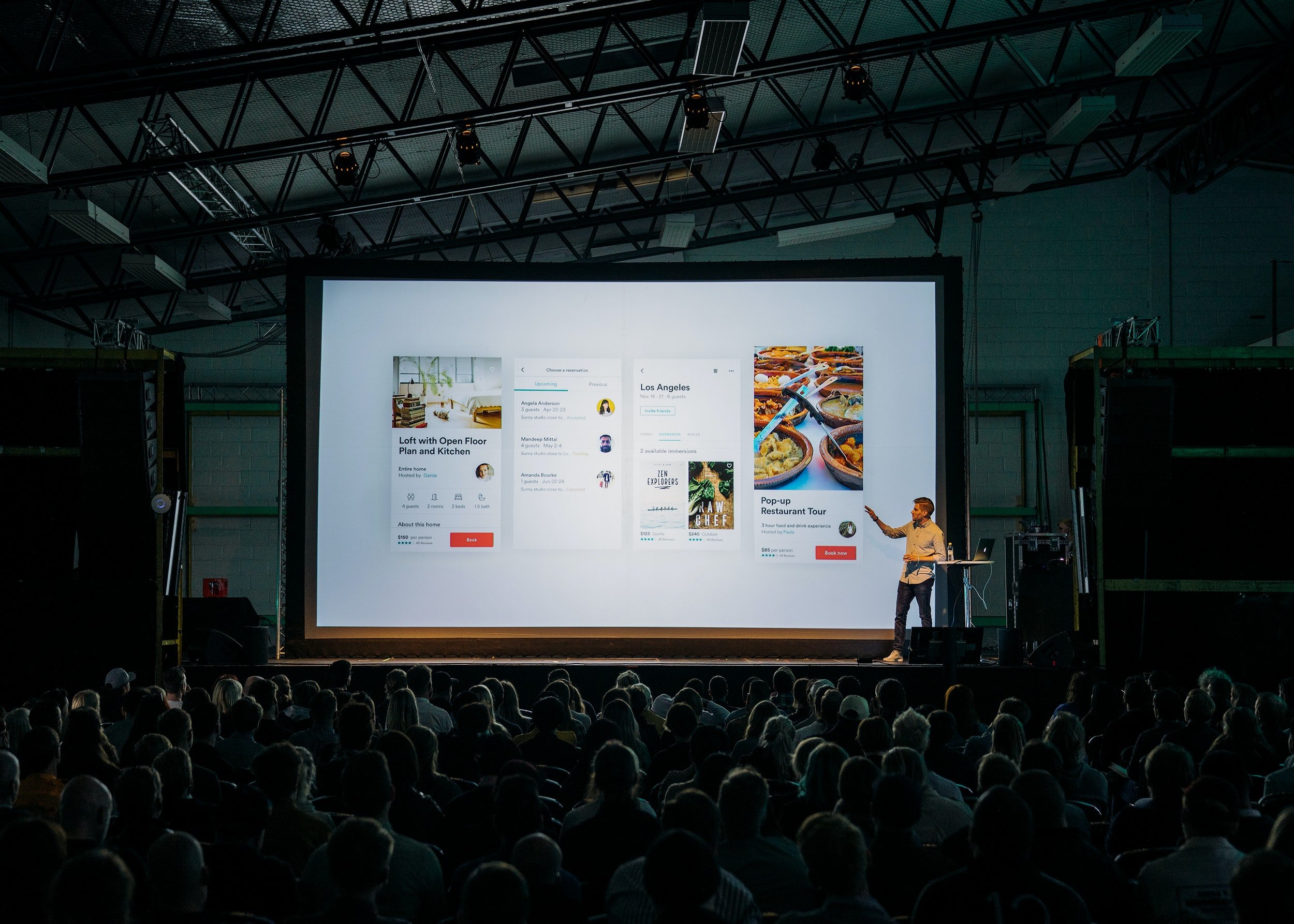
Presentations are essential in a business. People present their ideas or topics during speaking engagements, proposal meetings, and various events across different industries and sectors. But how do you make killer presentations that are impactful enough to draw your audience to your message?
Entrepreneurs and business executives nowadays are being tapped to talk about their experiences, expertise, insights and entrepreneurial journey stories to inspire others. Members of EO Melbourne share with us some tips on how to hook and attract your audience when presenting as well as keep them engaged and interested in your presentation.
1. Connect with your audience
“Be real.” This is what Jeremy Chen, Managing Director & Co-Founder of Good Things and Co-Founder of Hustleboard, imparts to those who want to learn how to deliver an effective presentation. The best way to make a connection with the audience is to be sincere and authentic in one’s words and disposition, and not try too hard to impress your audience.
This is backed by David Fastuca, CMO and Co-Founder of Locomote, when he said, “Just like how we do in EO, we're sharing experiences all the time. It is by making these presentations based on your experience or the experiences that you've delivered for your customers and bringing those results through because then they can say, ‘Well, I'm like this customer. I can get results like this based on how they did that.’”
True enough, the best presentations are those that can capture the attention of the audience, sustain their interest, and get them to retain the message you have conveyed. “The most effective ones I have done for the business are those where it is clear that I have been able to establish an emotional connection with the audience and they feel like they are part of the journey and the challenges that we have had along the way. Getting buy-in and interest from the audience from the beginning is so important,” shared Hayden Brass, Founder and Managing Director of Zea.
2. Make your slides visually pleasing
Renata Freund, Founder & Director of Honeycomb Strategy, shares valuable insights based on the work they do. “As a research agency, our success is centred on our ability to clearly communicate insights that are easy to understand and compelling. Here is one of our go-to tips and tricks to wow your audience with your presentation: Visual design is never optional.”
“When information, insights or data is presented in a format that is visually appealing, your audience will naturally be more open and receptive to what is being communicated. The visual design needs to come first, not be an after-thought in your presentation,” Renata remarked.
The visual design includes the template you use, the background of your slide, the colours, the layout of the presentation, the illustrations, photos and graphs that are included in the slides, as well as the font and size of the text. All these must be cohesive and well-thought-of to ensure that they are appealing to your audience.
3. Use fewer words and text
Renata adds another tip to wow your audience: Let imagery do the talking. “As a general rule, we try to keep the text on the slide to no more than a short heading plus 3 bullet points. We use photography and iconography as visual cues to support the story, without having to spell out every insight with words,” she said.
David concurs based on his experience as well. “The best ones have always been if you've got slides up on the screen or doing a zoom, know your basic things. It's common sense now these days, but a lot of people still get it wrong, which is not to have too many words on a page. Try to have more pictures that convey what you're saying on screen so that they're not reading something word by word, but they're getting the gist of what you're saying by the imagery that's on there.”
Jeremy summarises it in two words – “Be concise.”
4. Let your personality shine through
The third tip Renata has in making an impactful presentation is to “Let your personality shine through.”
She expounds, “The one thing that all great communicators have in common is the ability to let their personality shine through. Your presentation should be no different. Bringing fun, humour and your own personal touch to your presentation will build credibility and warmth with your audience.”
5. Put some fun in your presentation
Speaking of fun, David shares that it can make a presentation more memorable to the audience. He reveals, “I try to make all my presentations a bit fun, such as having a meme or a gif that people can relate to or that could get a bit of a smile from the audience. It can be risky if it doesn't come off, but when it does, it has a real impact.”
He further added, “People will remember you as the one that made them smile and the one that made them feel good about the topic that you're talking about. Depending on what you're talking about, it could be a relatively boring or stale topic, so you want to lighten it up and have a bit of fun with it.”
6. Give good key takeaways
Lastly, adding a summary at the end of the presentation will make it easier for your audience to recall and digest everything that you’ve said. According to David, “Give people some really good key takeaways. It doesn't matter what you're presenting or what you're explaining, there's always something that people can learn. I found that doing a summary makes it easy for people to get key takeaways. I put them on one slide and allow myself to put a little bit of text there so that people can know what I'm talking about and they can write it down or screenshot it. I think that helps create a presentation that is impactful and engaging.”
Moreover, take time to practice and hone your skills. Take the opportunity to present when it comes knocking at your door. Better if you record your presentations and review them later on so that you can see how you can further improve your presentation skills.