

BLOG
A Night of Recognition, Connection and Celebration
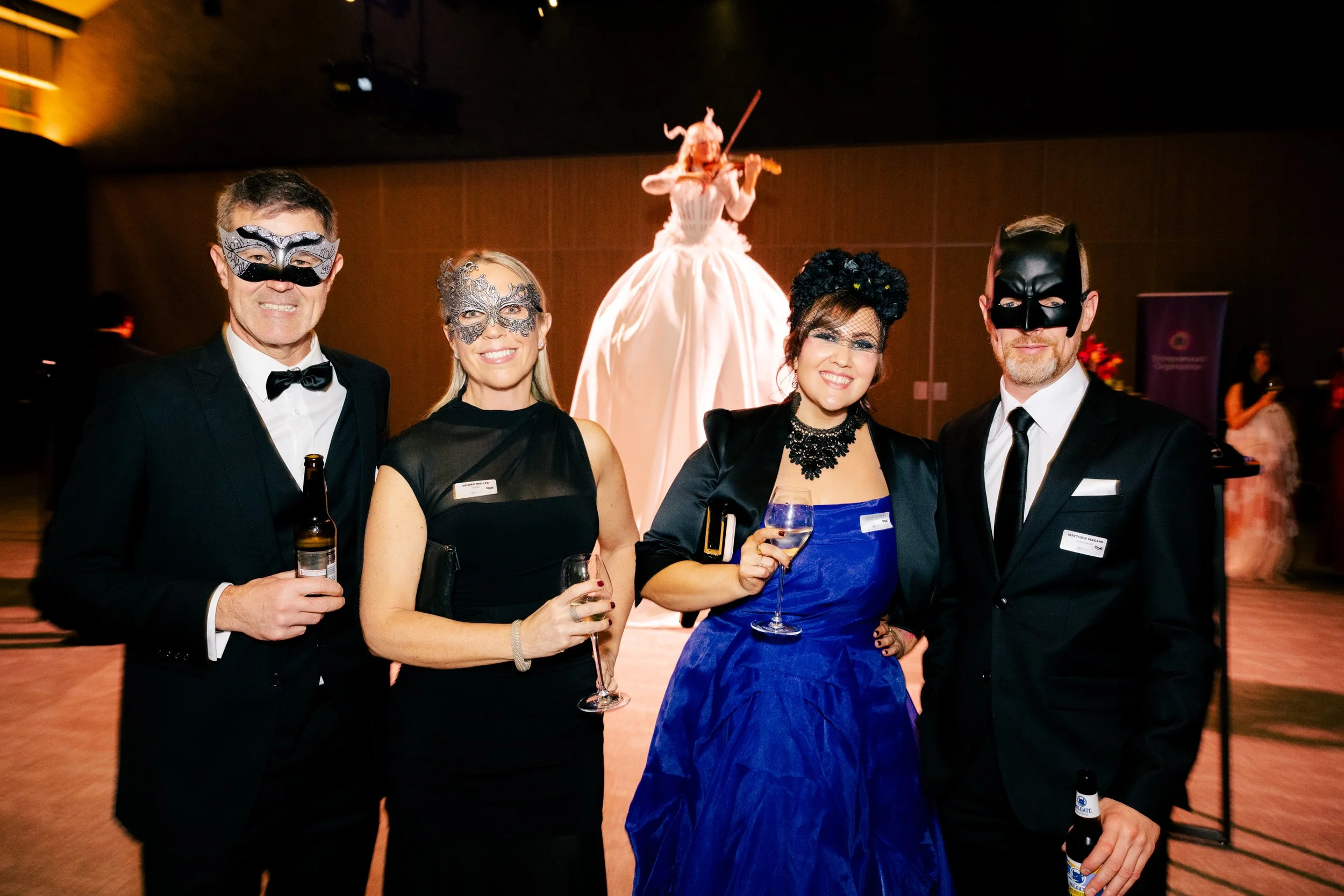
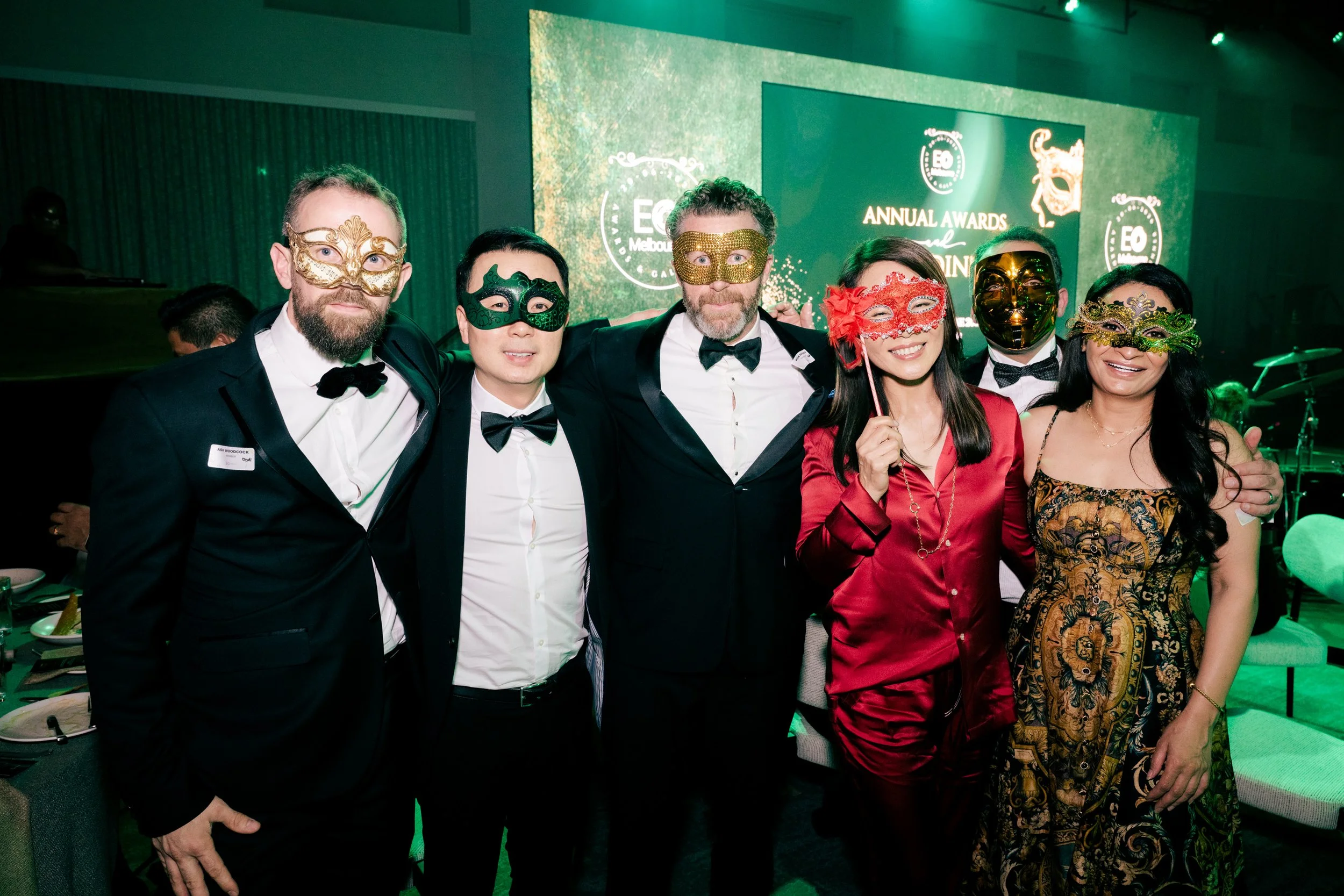
The EO Melbourne Annual Awards and Gala Dinner brought members, Strategic Alliance Partners and guests together for an evening of celebration at 1 Hotel Melbourne, recognising the people whose leadership, generosity and commitment shaped another outstanding year for the chapter.
Set against the theme UNITE: Better, Together, the evening reflected on a year of meaningful growth, stronger connections and shared success. President John Bevitt opened the celebrations by highlighting the chapter's achievements across its three strategic priorities: elevating the entrepreneurial ecosystem, creating diverse experiences and deep connection, and ensuring forums deliver transformational growth. A highlights video captured the energy of the past 12 months before the focus turned to the individuals who made those achievements possible.
The EO Melbourne Annual Awards and Gala Dinner brought members, Strategic Alliance Partners and guests together for an evening of celebration at 1 Hotel Melbourne, recognising the people whose leadership, generosity and commitment shaped another outstanding year for the chapter.
Set against the theme UNITE: Better, Together, the evening reflected on a year of meaningful growth, stronger connections and shared success. President John Bevitt opened the celebrations by highlighting the chapter's achievements across its three strategic priorities: elevating the entrepreneurial ecosystem, creating diverse experiences and deep connection, and ensuring forums deliver transformational growth. A highlights video captured the energy of the past 12 months before the focus turned to the individuals who made those achievements possible.
Recognising Excellence Across the Chapter
The evening began by celebrating the strength of the Accelerator Program, with Lana Zhang recognised as this year's Accelerator Graduate. Kate Slater was then named Accelerator of the Year, recognised for embracing every opportunity to learn, contribute and grow throughout the program.
The chapter also acknowledged the inaugural Navigator Program, thanking every member who volunteered their time to help strengthen connections across EO Melbourne. Natasha Marcello was awarded Navigator of the Year for her outstanding commitment to welcoming, supporting and connecting members throughout the year.
Leadership development also took centre stage as graduates of the LEAD Program were recognised for investing in their growth and preparing for the EO Path of Leadership.
Living the EO Values
One of the highlights of the evening was the presentation of the EO Melbourne Values Awards, celebrating members who embody the values that define the organisation every day.
This year's recipients were:
Together We Grow: Ina Karnath
Trust & Respect: Jake Ford and Gabriel Esseesse
Thirst for Learning: Rick Bazerghi
Think Big, Be Bold: Ben Simpson
Each award reflected nominations from fellow members, highlighting the everyday acts of generosity, curiosity, leadership and support that strengthen the EO Melbourne community.


Celebrating Entrepreneurial Achievement
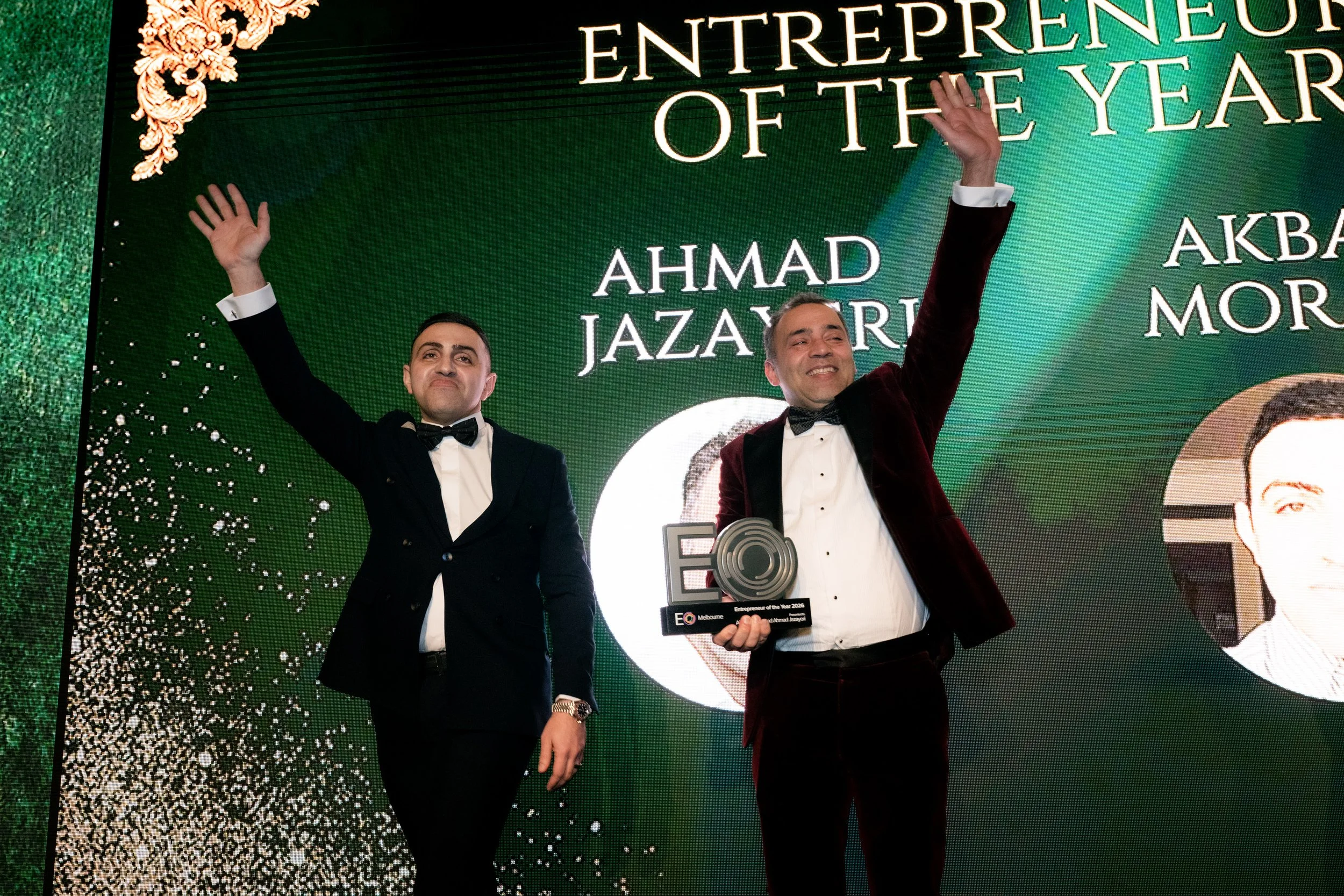
The evening's highest entrepreneurial honour, Entrepreneur of the Year, was awarded jointly to Ahmad Jazayeri and Akbar Moradi.
Together, they have built one of EO Melbourne's great business success stories, growing a national retail business beyond $100 million in revenue while embracing technology, innovation and expansion into new ventures. Beyond their commercial success, nominations consistently recognised their humility, generosity and willingness to support fellow entrepreneurs, qualities that exemplify the spirit of EO.
President John Bevitt then presented his President's Award to Foong-Yue Cheah, recognising her exceptional contribution to member engagement throughout the year. By stepping into a newly evolving leadership role and building a thriving engagement committee, Foong-Yue helped ensure more members felt connected, supported and able to maximise the value of their EO experience.
Within the Forum community, Jamie Lingham was named Moderator of the Year, recognising his outstanding leadership and commitment to creating transformational Forum experiences.
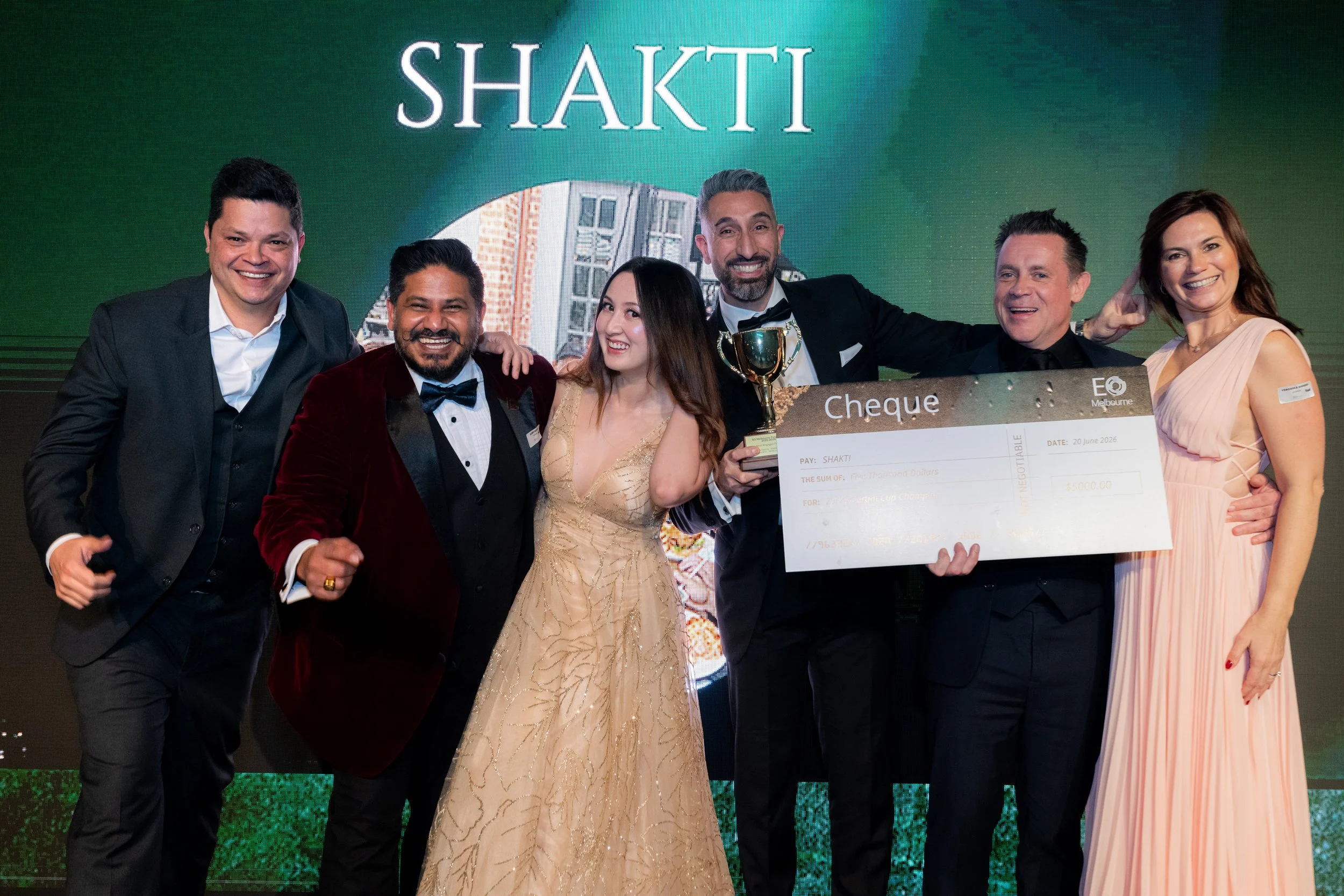
The chapter also celebrated another successful year of the Forum Cup, recognising quarterly winners throughout the year before crowning Shakti, moderated by Jamie Lingham, as the FY 2025/26 Forum Cup Champion.
Looking Ahead
As the formal proceedings drew to a close, EO Melbourne recognised the outgoing Board for their dedication before John Bevitt reflected on his year as President, thanking the Board, chapter staff, volunteers and members who helped bring the chapter's vision to life.
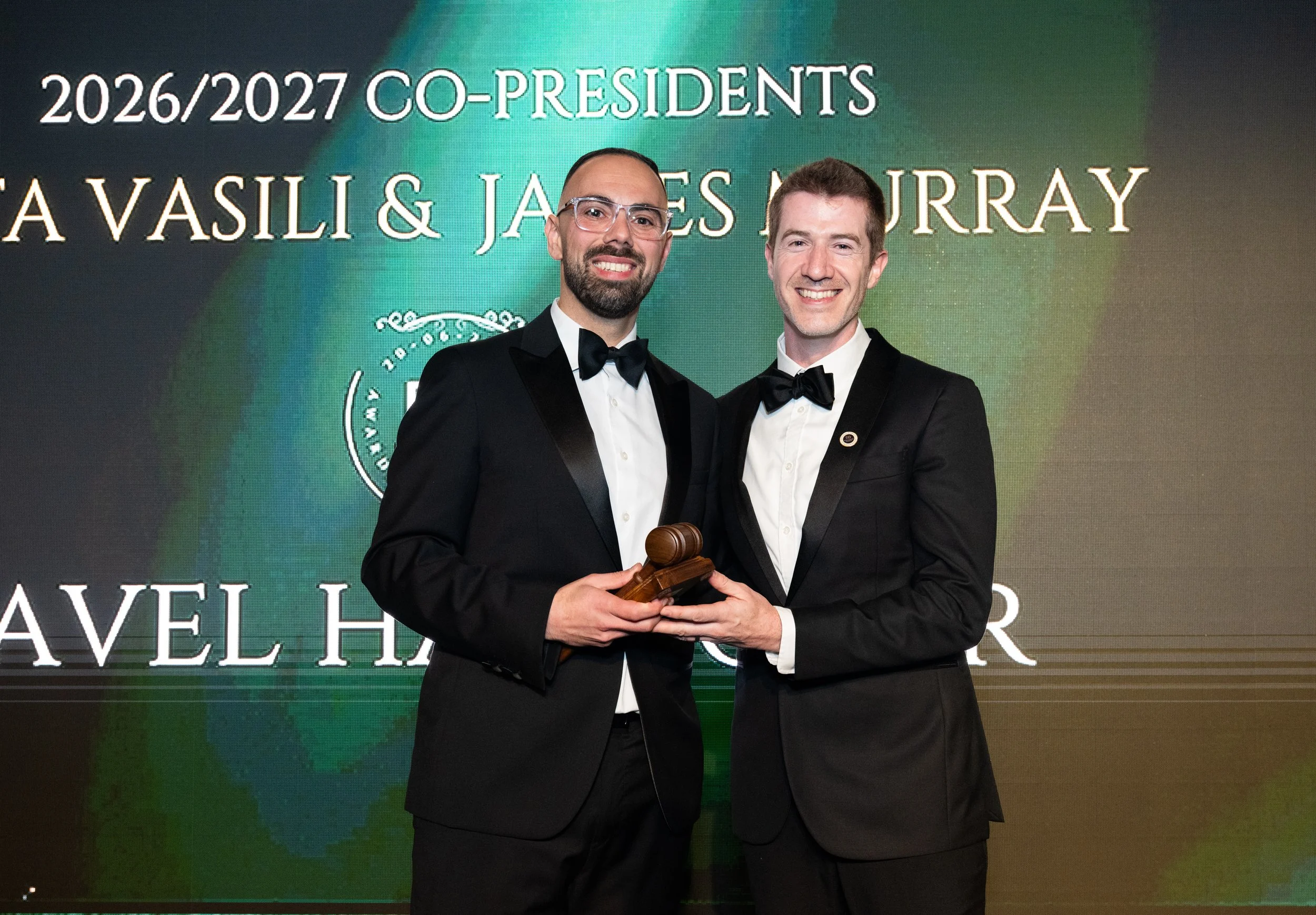
The evening concluded with the ceremonial handover to incoming Co-Presidents Costa Vasili and James Murray, who unveiled the FY 2026/27 chapter theme, Think Big, Be Bold, along with the strategic priorities that will guide EO Melbourne into the year ahead.
With awards presented, achievements celebrated and a new chapter beginning, members finished the evening on the dance floor as live entertainment from The Drop capped off a memorable night, one that celebrated not only success, but the people and relationships that continue to make EO Melbourne stronger together.
Mentorship Story: Reflecting from the rearview mirror to drive forward on the entrepreneurial highway
To be a better leader – this is the goal this year of James Murray, Founder and Managing Director of Work Healthy Australia. And for him to drive himself forward in achieving this goal, he recognises the value that the mentorship program is offering entrepreneurs like him, who aims for continuous personal and professional growth.
James is thankful to have Steve Sacks, Chairman of Sonnant, as his mentor because of the value that their relationship has brought to James’ professional development. “My journey for my self this year is to become a better leader, which means to become a better listener. Steve has been very helpful. Even if I've only changed 1% or 2%, I attribute a lot of that to some of my conversations with Steve because he's just such a good listener,” James professed.
To be a better leader – this is the goal this year of James Murray, Founder and Managing Director of Work Healthy Australia. And for him to drive himself forward in achieving this goal, he recognises the value that the mentorship program is offering entrepreneurs like him, who aims for continuous personal and professional growth.
James is thankful to have Steve Sacks, Chairman of Sonnant, as his mentor because of the value that their relationship has brought to James’ professional development. “My journey for my self this year is to become a better leader, which means to become a better listener. Steve has been very helpful. Even if I've only changed 1% or 2%, I attribute a lot of that to some of my conversations with Steve because he's just such a good listener,” James professed.

For both James and Steve, their mentor-mentee relationship is like a two-way street where they get to learn from each other and be inspired by what the other has done in his entrepreneurial journey, notwithstanding the differences they have in their respective phase in the journey.
Restoring things to make them more efficient
Steve has enjoyed being a mentor to James because of the many facets of entrepreneurship that James brings to the table. “I've enjoyed hearing James' agenda of activity, like the amount of stuff that he packs into a week is pretty inspiring. But I've enjoyed telling him to slow down as well. I've found great value in learning about a completely different sort of business sector. Well, it’s two actually, between the egg farm and Work Healthy Australia. And also, I like hearing about James' various non-work activities like his passion for old Saabs,” Steve shared.
Whilst Steve is learning from James’ involvement in such a diverse range of activities – both business and personal interests – he is also imparting with James some of his learnings from his entrepreneurial journey. “One of the things we've talked about has been around where James’ company is at now, with 70 staff members. I've taken a couple of companies from startup up to that number of people, and some of the challenges that you face when you get to around 25 and then around 50 are that the management structures typically need to change. Some of the control needs to devolve. Some of that I learned painfully and I think most founders learn painfully even if they hear it from somebody else. But I've tried to reflect on that in some of the conversations with James as he goes through that same challenge. I'm sure he'll get through it,” Steve said.
From Steve’s experience, James could draw out his thoughts and realisations and then apply them to his business, hoping to make it better, the same way as to making his Saabs up and running. “It’s helpful hearing about what you have to do at 25 people, which is a lot different than what you have to do at 50 and how different those businesses are because, for me, I've just been adding a couple of people at a time. I haven't looked at it like it’s 25 then 50. That reflective view, back in the rearview mirror, is helpful because as an entrepreneur, sometimes we don't want to let go of things, especially if they were like our favourite thing or they were something that we used to think we're good at. That ability to recognise that you've got to let some stuff go to let other people do well is a great experience to hear,” James reflected.
He added, “When Steve shares some war stories from a couple of the other business he was in – some of his tough times, the hard things that he's had to get through and the hard decisions he's needed to make – those are awesome learnings because typically in my experience, I've had to make every mistake to learn from it. Those are much cheaper lessons to work my way through, so I appreciate how genuine and how deeply Steve shares them with me.”
Slowing down but moving ahead to the future
Driving a bus loaded with a lot of people towards the goal can often be tiresome for entrepreneurs. Trying to accelerate their speed to get to their destination faster can sometimes take a toll on their wellbeing, which may affect their families, businesses and those who rely on them.
In James’ situation, “There's a lot of people around me right now. I've got 70 staff members and four kids as well, and everyone just wants a little bit of me. They just want to pull me here and there. Sometimes, I don't know how to say ‘no’. It's great that I like to help people but it's also really hard on me. What I've learned from Steve, and he’s good at telling me this, is to just slow down a little bit or make a better choice or just find some time to turn down the volume in my brain and chill out. I think that's good because no one who works with me is going to tell me that. Having someone external to me who can just say, ‘hey James, grab a hold of that volume button and turn it down a couple of notches.’ It's helpful because I can't see myself from an outsider's perspective. That deeper reflection from a good place has been helpful. I have learned a lot from that.”
“Steve's been successful and he's done a lot of great things. He's in a different phase than me. That phase where you get to pick and choose what you want to do and you don't have a lot of people who are on to you all the time, that ability to embrace your own choices and then also be disciplined within your own choices and enjoy those, it has given me a lot of hope for the future and a lot of inspiration to create my own life,” James remarked.
Driving the Mentorship Program forward
As a former EOer himself, Steve appreciates how mentoring is done in the organisation. “The past few years, I've been doing increased involvement in more informal types of mentorship situations, but given this is EO and I can relate to the culture and the ethos of experience-sharing rather than telling people what to do, I thought that it'd be a good one to have a more formalised kind of mentor-mentee relationship. I think part of it is that we're trying to keep to a reasonable structure here. I think it has worked well trying to structure the program and have some intentionality into what you're going to cover and how you prepare them.”
On the other hand, for James who is currently the Mentorship Chair, the program is a significant pillar of the chapter. So, while he works towards further strengthening the program, he also participates in it as a mentee and gets various benefits from it. “I think it's a great program because if you look at the calibre of mentors that we've attracted into the program this year in Melbourne, and we're talking about over 30 mentors now in in the program, we've got some incredibly experienced individuals and they're volunteering which is amazing. I love the program and I’m going to do it next year. Because the maximum that you can do in EO is three years, I think I'll probably keep it for the third year. I’ll try and build it up to be a real cornerstone of the chapter experience for the members of Melbourne. I don't think there are any downsides being part of it.”
Moreover, James couldn’t stress enough the idea that “Mentorship creates the environment through which both of us can share our experiences for mutual benefit. I hope that Steve would like to continue our relationship after the official mentorship is over. This isn't a business transaction and the mentorship relationships provide critical value that is added to our membership in Melbourne. This is part of our entrepreneurial journey where we can continue to learn and grow.”
----
If you’re an EO Melbourne Member, have you already signed up for the next mentorship intake? Find out more on our Mentorship page.
EO Melbourne Members who were recognised in 2020 for their outstanding achievements
The year 2020 is perhaps one of the most challenging times due to the current global crisis that everyone is experiencing. Yet, amidst the sullenness that the pandemic may have brought upon us, some shine bright, inspiring and encouraging us to keep on and face the difficulties with optimism and determination.
Among them are entrepreneurs and companies that have been recognised by various institutions and organisations in their respective industries for the hard work and brilliance they have shown through their businesses.
The year 2020 is perhaps one of the most challenging times due to the current global crisis that everyone is experiencing. Yet, amidst the sullenness that the pandemic may have brought upon us, some shine bright, inspiring and encouraging us to keep on and face the difficulties with optimism and determination.
Among them are entrepreneurs and companies that have been recognised by various institutions and organisations in their respective industries for the hard work and brilliance they have shown through their businesses.
2020 SmartCompany Resilience Awards

Since its inception in 2007, SmartCompany has been paying tribute to the fastest-growing SMEs in the country through its Smart50 Awards. While it took a break in 2019 and was bound to come back this year, present circumstances have stirred it to change tracks and recognise companies that have exhibited the knack for problem-solving, flexibility and rebounding from disappointments. Thus, the first-ever SmartCompany Resilience Awards was conceived.
There are four categories: Adaptation, Community, People and Agility. Five businesses were shortlisted per category and one of them was announced as the winners by a panel of judges. Work Health Australia, founded and owned by Dr James L Murray, bagged the top position in the People category “for its focus on keeping its team connected and productive during Victoria’s multiple lockdowns.”


Other shortlisted businesses by EO Melbourne Members are Arosh Fernando’s Woohah Productions and Mark Calabro’s HungryHungry under the Adaptation category.
TEMI’s 2020 Australasian Mobile Workforce Awards

The Employee Mobility Institute (TEMI) introduced the Australasian Mobile Workforce Awards in 2019 to give merit to those who excel in the talent mobility industry, ranging from talent management to HR, employee engagement, remuneration, taxation, relocation, mobility, immigration, diversity and inclusion, corporate travel or housing, and other disciplines related to this field.
The Award Program acknowledged individuals, teams and initiatives in the industry at a local and regional level. Twelve awardees were honoured in this program; three winners each for the Leadership Excellence Awards, Business Advancement Award, and Employee Engagement Awards; and one awardee each for the Employee Mobility Champion of the year: Highly Commended Award, 2020 GMP1 Outstanding Achievement Award, and 2020 GMP1 Highly Commended Award.
Jamie Lingham, Global Immigration Lead of Absolute Immigration, is hailed as one of the Employee Engagement Awards Winners. “Receiving The Employee Mobility Institute’s award for Wellbeing Initiative of the Year for 2020 was a huge honour, especially given the impact COVID has had on the mobility and immigration industry. With passenger arrivals to Australia down by 99%, our objective was to keep the team engaged and employed while retaining the investment and corporate memory of the business. We know that the investment made in employee wellbeing will pay dividends into 2021 and beyond!” he said.
ARN Women in ICT Awards 2020

The Women in ICT Awards (WIICTA) was launched in 2012 to honour the accomplishments of female innovators and leaders who have played notable roles in the local ICT industry.
This year, over 110 individuals were included in the final shortlist in the following categories: Entrepreneur, Rising Star, Shining Star, Community, Technical and Achievement. Under the Shining Star – Partner category, Jeni Clift of DWM Solutions is among the finalists. The Shining Star awards are candidates that have eight or more years of experience in the ICT industry and have significant feats in a flourishing profession, as shown through milestones and successful projects.
“I was thrilled to be recognised within my industry as a Finalist in the category SHINING STAR – PARTNER of ARN’s Women In ICT Awards. I am familiar with the calibre of women who work in this industry and am honoured to be included amongst leaders who are making a difference!” Jeni expressed.
Ragtrader’s The Power 30

Every year, Ragtrader, a publication that comes up with news, features, analysis and opinion on Australia’s clothing, footwear and accessories sector, celebrates people in the industry that have innovated and created a remarkable impact in eCommerce, retail and design.
This year, among the influential fashion traders that made it to the Power 30 list is Lee Munro of Munro Footwear Group. Its productive partnership with suppliers, especially with the challenges that 2020 has brought, has helped them overcome obstacles in inventory.
-----
Congratulations to all business leaders who have been recognised this year and cheers to all entrepreneurs that have braved the proverbial storms and painstakingly led their teams through the crisis. You all deserved a pat on the back for all your efforts to navigate through the current situation.
The importance of mentorship in the entrepreneurial journey
The entrepreneurial path can be quite daunting for those who are contemplating to take it. But even when you’re already in the journey, there are times when the ride can be tough and you seem to be lost midway due to the pressures coming from various directions. Having a guide, someone that has been through this before, to point the way can help ease the anxiety of not knowing what lies ahead and can even be instrumental in accelerating things. This is where mentors come beneficial to one’s entrepreneurial journey.
Entrepreneurs Damian Blumenkranc, Co-Founder of Creativa, Attento, and Just Click Videos, among others, and Benjamin Trinh, Founder and Managing Director of Life Ready Health Group share that having mentors have helped them in the success of their endeavours. Apart from being on the receiving end as mentees, both have also become mentors to other entrepreneurs, helping others in their businesses as well.
The entrepreneurial path can be quite daunting for those who are contemplating to take it. But even when you’re already in the journey, there are times when the ride can be tough and you seem to be lost midway due to the pressures coming from various directions. Having a guide, someone that has been through this before, to point the way can help ease the anxiety of not knowing what lies ahead and can even be instrumental in accelerating things. This is where mentors come beneficial to one’s entrepreneurial journey.
Entrepreneurs Damian Blumenkranc, Co-Founder of Creativa, Attento, and Just Click Videos, among others, and Benjamin Trinh, Founder and Managing Director of Life Ready Health Group share that having mentors have helped them in the success of their endeavours. Apart from being on the receiving end as mentees, both have also become mentors to other entrepreneurs, helping others in their businesses as well.
“I have experience at both ends, been a mentee and a mentor many times, and planning to continue getting mentors and helping others.”
- Damian Blumenkranc, Co-Founder of Just Click Videos

From his experience being a mentee and later on as a mentor, Damian recognises the value of mentors in one’s entrepreneurial journey. “Having mentors has been critical to my success in business. It can take years to go through the experiences and the mistakes you need to make to know what to do best in each situation. As entrepreneurs, we face new challenges daily and having someone that can guide you through those hard or strategic challenges based on their success & failure experiences can mean a life-changing difference,” he stated.
Yet, to be able to give back by guiding others has become a fulfilling experience for Damian as well, providing him with a different perspective and understanding as a business owner. “As a mentor, it is extremely rewarding to not only see your mentees’ businesses flourish, double and triple, but also to know that all those hard-earned experiences are useful beyond your realm and gives you the energy to tackle any new challenges to come, hopefully with the help of a mentor to guide you through it as well.”
Choosing a good mentor to guide you may not be easy. But there’s no need to look too far, according to Damian. “For those that haven't had a mentor before, I think the best mentors are not necessarily those that are 100 steps ahead of you (they are great for contacts and inspiration), but those that are just 2-3 steps or maybe 3-5 years ahead of you because they will not only be able to relate better to your situation but also have fresher memories similar to what you are facing and a contemporary approach to solving your current hurdles.”
“Ensuring people have access to mentorship ensures they learn and grow within your organisation.”
- Ben Trinh, Founder & Managing Director of Life Ready Health Group

Ben has experienced the benefits of having a mentor in shaping his growth as an entrepreneur. “When I joined EO at 23 years old, my business had barely scraped over the $1 million and Accelerator hadn't existed. Thankfully, some mentors helped guide and shape my business into what it is today,” he said.
Acknowledging the value of mentors to startup owners like him, he later went on to guide other entrepreneurs who are in the same situation he once had. As a result, Ben shared, “I participated in the EO mentorship program as a mentor for 2 years. Apart from that, I also sit on numerous advisory boards and provide help to other founders.”
Moreover, he found that mentorship done internally is also significant when running a business because it develops the people within that organisation. “Succession planning is critical in any business. Without it, businesses get stuck with young people leaving for other opportunities elsewhere. Ensuring people have access to mentorship allows them to learn and grow within your organisation. It also ensures you are replicating the strong aspects of your key people for each of your managers. In our corporate culture, we must ask, ‘who will replace you?’ This culture, combined with forum-style governance, has allowed us to scale from 3 people to now over 400 across 3 states,” he shared.
EO Melbourne Mentorship Program
EO Melbourne Mentorship Chair Dr James L Murray revealed how the chapter is working on this program to help entrepreneurs learn from others who have the experience to guide them in their journey. “This year, we have gone above and beyond to recruit some amazing Mentors from outside the chapter. Some are absolute rock stars in the Melbourne entrepreneurial community. There are also many YPO members and lots who have exited multiple times successfully.”
According to James, “Mentorship ranks as the #2 member experience after their forum. The program ranks higher than learning events, retreats and universities. For a small-time investment of only 20 hours for the year, they may meet and get to know someone who can change their life and their business forever. Also, training in how to be both a Mentor and a Mentee will serve them in all aspects of their life.”
If you are interested to know more about this program, visit our Mentorship page for more details.