BLOG
The One-Page Business Plan Workshop: Revolutionising Business Strategy for EO Melbourne Accelerators
EO Melbourne recently hosted an enlightening workshop aimed at transforming how business owners approach their strategic planning. "The One-Page Business Plan" workshop, led by EO Melbourne Member Cesar Aldea—Managing Director of Aldea Consulting and Founder of cesaraldea.com.au—offered participants a fresh perspective on planning for success.
Renowned for his extensive expertise, Cesar guided attendees through crafting a compelling vision that aligns with their core values. He underscored the significance of developing a solid strategy tailored to each individual's unique risk tolerance and skill set. The workshop's goal was to transition participants from relying on intuition to adopting a more strategic approach, ensuring that their objectives extend beyond simple revenue targets.
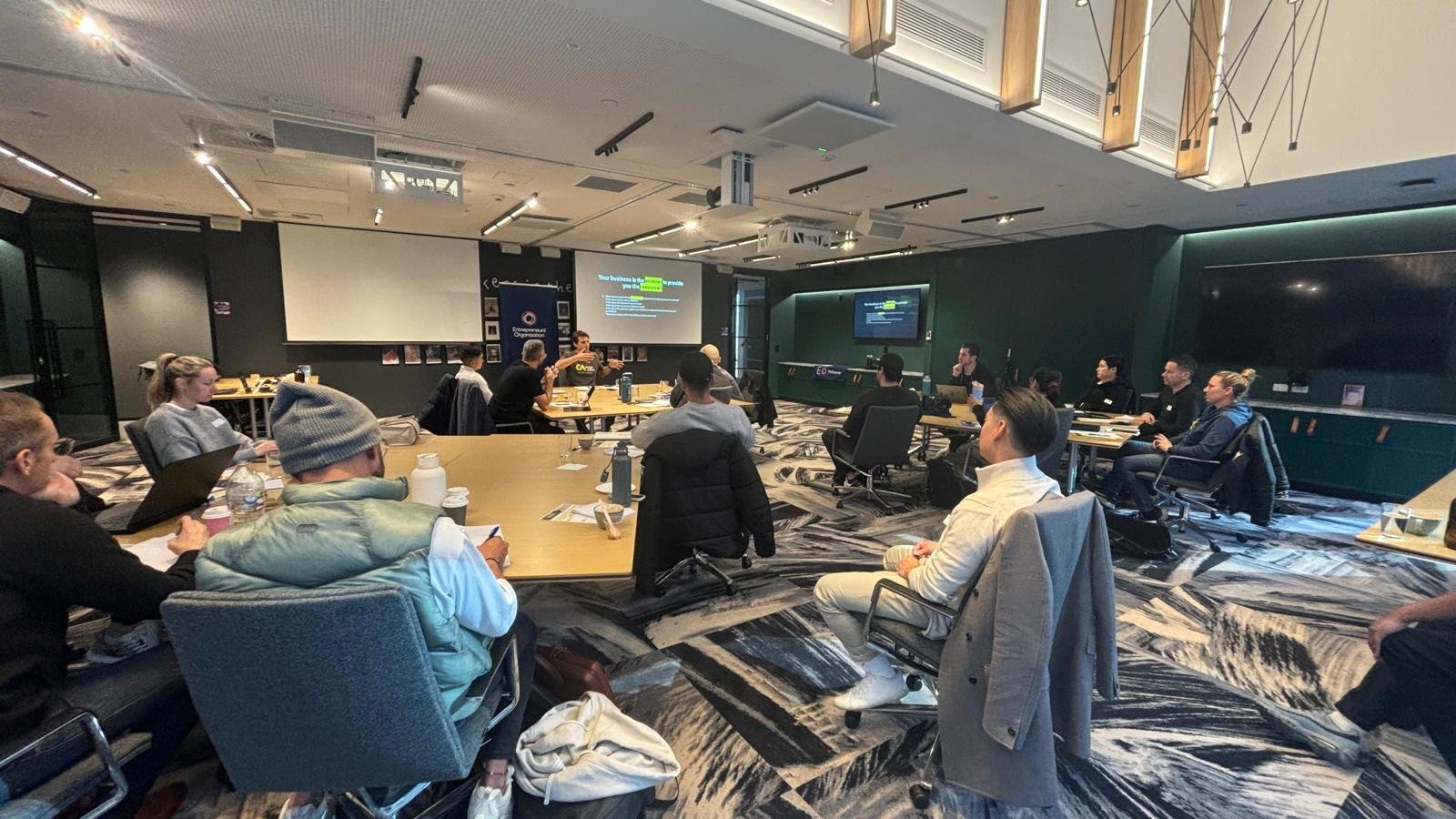
Throughout the session, participants learned to define success in broader terms, integrating happiness and well-being into their goals. They recognised the importance of having a clear vision and strategy to avoid aimless efforts. By assessing their risk tolerance, attendees gained valuable insights for making informed decisions, ensuring their strategies were both ambitious and attainable. The workshop also emphasised a holistic view of business, advocating for a balance between health, wealth, and relationships. Cesar encouraged participants to align their business vision with their ideal lifestyle, incorporating aspects such as exercise, nutrition, spirituality, and hobbies.
Cesar, a Social Impact Entrepreneur and Business Coach focusing on SMEs, is the director and founder of several ventures unified by a common vision: using purposeful businesses to create a better world. As a coach, he aids business owners in achieving sustainable growth through guidance, support, and accountability. His structured approach, based on the 3 Pillars of Success—Wealth, Health, and Relationships—ensures that business owners build enterprises they love, which also reciprocate that affection.
The workshop was part of the EO Melbourne Accelerator Program, which supports early-stage entrepreneurs in overcoming the challenges of business growth. This programme offers invaluable resources, including expert-led workshops, mentorship from seasoned business leaders, and a supportive community of peers. By concentrating on critical areas such as strategy, leadership, and execution, the Accelerator Program aims to equip entrepreneurs with the skills and knowledge necessary to scale their businesses effectively and sustainably.
EO: A strong business support system during challenging times
“Alone we can do so little; together we can do so much.” – Helen Keller
A few years back, no one has ever imagined that we would be experiencing this tough global crunch that we have today. Every corner of the world has been affected by the pandemic, affecting many industries and economies. It is undeniable that it has also taken a lot of toll on business owners.
“Alone we can do so little; together we can do so much.”
– Helen Keller
A few years back, no one has ever imagined that we would be experiencing this tough global crunch that we have today. Every corner of the world has been affected by the pandemic, affecting many industries and economies. It is undeniable that it has also taken a lot of toll on business owners.
However, being among peers and colleagues and surrounded by like-minded individuals who are going through the same worries and lending support to each other can be a huge help during this time of crisis. As depicted in a fable, a single stick can be easily broken while it would be difficult to do it on a bundle of sticks.
The same can be said for entrepreneurs who have strong support from a group like EO. For members of EO Melbourne, the chapter is a huge help and comfort as they navigated through the crisis. One of the benefits that they pointed out in belonging to this group is the Forum.
Jason Ellenport, Principal at Edison Partners, echoed this sentiment. “Above all else, it was my forum which assisted me to navigate the crisis. We went to twice forum meetings per month to ensure we were there for one another.”
Information sharing
At a time when movements were limited and things were at a standstill, connecting with people is essential and helpful. It is also necessary for business owners, especially in getting the necessary information about various industries and recommendations for leads.
“The (EO Melbourne) WhatsApp group helps a lot by quickly sharing information and links to resources. Because of the rapidly changing nature of the COVID-19 crises, it was good to have information shared so quickly and, more importantly, verified or dismissed as a rumour. We changed our forum to twice monthly, which helped to disengage from the frenzy and take a higher-level view of life with the other forum members,” said Liston Newton Advisory Director John Liston.
These sharings also includes first-hand experiences, especially on products and services that others have availed and used. For RetailCare Founder Carlo Santoro, the network of connected like-minded people has helped him ensure that he stays on top of all the latest ideas and government regulations by learning from the experiences of others.
Relatability
Having someone or a group that understands what you are going through is very important at this crucial point of our global events. People who can empathise with your situation can often help lift the burdens that you have been carrying all along.
According to Cesar Aldea, Founder and Managing Director of Aldea Consulting, “As a group of business owners, we shared our challenges, fears and wins during these difficult times. The level of relatability makes the group a safe platform to share EVERYTHING that’s happening to you personally or with your family and business.”
Supporting each other
When one is going through difficulties, whatever kind of help – big or small – can go a long way. “Certainly, having my forum has been the biggest support,” Cesar declared.
Gry Tomte, HÜD Skin + Body Director + Founder, still remembered how it was when the pandemic started. “I was fortunate enough to start EO at the beginning of COVID. I remember clearly my forum training with Carlos the very day everything went haywire. One of my first experiences was a breakfast meeting where listening to so many EO members already having lost their entire business – but with the resolve to turn things around – was a humbling, emotional and pivotal moment.”
She further elaborated, “When I was placed in a forum, I had no idea what to expect. It’s taken me a long time to understand exactly what forum is about. But now that I do, I can honestly say my forum has pulled me through some of the most difficult times I’ve ever experienced in business and life. I said this just recently, ‘I am so lucky to have stumbled into this forum at the perfect time.’ Having a group of absolutely awesome humans with such vastly different but often with the same core experiences is priceless. It’s such a blessing knowing you’re not alone. And all the things you go through as an entrepreneur, while it seems as though everyone else is breezing through it, most have been there or will be there. Oftentimes, we can’t see the gold because we’re too absorbed in digging through the dirt. My forum had helped me see the gold in so many situations. I’m forever grateful for joining EO.”
At this time, we may still not know what the future – short-term or long-term – holds for every one of us. But having a strong support business during a challenging entrepreneurial journey can help you stay on track and continue towards your goals by a considerable margin than when you’re all by yourself. Helen Keller’s inspiring quote “Alone we can do so little; together we can do so much” still rings true in our present time.
On trends and predictions: how it will help chart your business growth
Setting targets and goals is an important part of keeping a business running. It provides the team with the direction of where the company is heading and allows them to come up with strategies based on the objective set. Looking ahead may include forecasting, which helps gauge if the target is attainable and feasible within the given timeframe and resources on hand.
Entrepreneurs prepare for the future by looking at trends and coming up with a prognosis of what is to happen. EO Members share how they keep themselves updated on the latest trend in their industry.
Setting targets and goals is an important part of keeping a business running. It provides the team with the direction of where the company is heading and allows them to come up with strategies based on the objective set. Looking ahead may include forecasting, which helps gauge if the target is attainable and feasible within the given timeframe and resources on hand.
Entrepreneurs prepare for the future by looking at trends and coming up with a prognosis of what is to happen. EO Members share how they keep themselves updated on the latest trend in their industry.
I talk to suppliers and partners to get to understand where the business is changing, as well as to the leading businesses in each industry category that we work in. – Carlo Santoro, RetailCare Founder
Being an avid reader certainly helps with staying abreast of the latest trends in the translation and localisation industry. In my spare time, I regularly read global industry news, blogs and reports. When I am on the move, I also listen to industry podcasts. I also enjoy exploring research papers from academia to help understand how research and evaluation can help influence our translation company. Finally, staying connected with other professionals in the industry, including attending networking events, as well as arranging one-on-one meetings has been incredibly valuable. – Costa Vasili, EthnoLink CEO and Founder
I read a lot of books, listen to podcasts and follow thought leaders on LinkedIn. – John Liston, Liston Newton Advisory Director
Edison has M&A Advisory, Strategy & Transformation Consulting and Private Equity business lines, so it’s important I’m up-to-date across all three areas. To do so, I read extensively, listen to podcasts – including www.Disciplinn.com (which Edison proudly sponsors) – but most importantly, I engage with entrepreneurs and business owners to understand their priorities and listen to how their respective landscapes are changing. – Jason Ellenport, Principal at Edison Partners
Watching out for trends and conducting research enable business owners to have a foresight of what to come. It may not be 100% accurate, but it gives one a preview of what to expect and prepare for possible opportunities and threats. It also provides a different perspective on how we would be doing things and have a better understanding of things around us.
And what are some of the business predictions entrepreneurs have for the rest of the year? Here are a few we’ve gathered from our members:
I believe many businesses have simply realised the number of unnecessary processes-protocols-routines that are nothing more than decorative stuff, mostly a waste of time and energy that until now has never been questioned. Today, we know that people can be more productive working from home and managing their own time. We know that we don’t always need fancy offices; that you can maintain relationships without travel; and that Zoom overtime sucks! I’m predicting a simplification to the way we do business. This is the time when we have the opportunity to adjust our work our lifestyle and start living the life we always wanted. – Cesar Aldea, Aldea Consulting Founder and Managing Director
Heightened activity in M&A markets, with continued domestic and cross-border inbound interest in ANZ assets. – Jason Ellenport, Principal at Edison Partners
Integrations and automation is the biggest growth area for business in 2021. – Carlo Santoro, RetailCare Founder
Staff will not go back to normal pre-COVID work. As a business, we’ve seen the fall out of extended lockdowns and the way it’s affected how people prioritise work-life balance. Several team members have decided that travelling 2 hours every day for a job they love with an incredible culture - isn’t enough when they can work 5 minutes from home and be home at 5 every day. Priorities have shifted with people working from home and I am expecting many offices will see their people demanding to spend some of their time working from home with more flexible hours. I think we’ll also see a lot of people changing careers. – Gry Tomte, HÜD Skin + Body Director + Founder
Increased volatility in listed-equity markets will likely drive an increased appetite for alternative private equity investment classes. – Jason Ellenport, Principal at Edison Partners
E-commerce and digital products will be bigger than ever. I can see that the convenience of having everything accessible online at any time is something that won’t be going anywhere. And I think this world will see a lot more exciting innovation in the coming years as companies have pivoted their technology and operations to adjust to a covid normal. But I think the businesses in the tech space who will do best are those who have a broader purpose clear to the consumer. Even though we’ve gone online people still crave connection and genuine care. – Gry Tomte, HÜD Skin + Body Director + Founder
High growth for all business that is focused and listening to their customers. – Carlo Santoro, RetailCare Founder
My biggest prediction is that people will prioritize happiness; spending more time doing the things you love with those you love, over money and career. Therefore employers will need to shifts their focus from KPIs to KHIs to motivate, retain and attract new people. – Cesar Aldea, Aldea Consulting Founder and Managing Director
How about in your industry? What are the trends you currently see and from those, what predictions can you formulate for the rest of the year and the coming year? Share with us your thoughts through the comment section below.
Entrepreneurs' biggest lesson learned in 2020
The year 2020 may be one of the most challenging times that everyone, including entrepreneurs, has experienced. Despite the hardships we experienced due to COVID-19 that has disrupted many lives, the hurdles and struggles have also brought us a lot of lessons and learnings, especially to business owners who have to survive for their teams, families, customers and other stakeholders.
EO Members share the biggest lesson they learned from the previous year, with the hope of taking their learnings with them as they move forward in their entrepreneurial journey.
EO Members share the biggest lesson they learned from the past year, with the hope of taking their learnings with them as they move forward in their entrepreneurial journey.
Acknowledge your vulnerability
“The power of vulnerability.” This is the fundamental realisation that Cesar Aldea, Aldea Consulting Founder and Managing Director, has gained from his experiences last year.
“At the start of the pandemic, our business was booming. We had 10 full-time doctors working with us across 4 states. As a General Practitioner Locum Agency, we thought COVID will bring more work for us. However, the 40% drop in patients attending GP clinics forced our clients to cancel the service. The impact on our business: we went from 10 FTE (Full-Time Equivalent) dropping to 1 FTE within 72 hours. Our revenue fell by 90%. The worst part, and at the same time the most relevant, was having those hard conversations with the doctors (90% of our workforce) to let them know they’ve lost their jobs,” Cesar recounted.
But he didn’t let these ordeals get the better of him. “I knew the way we handled this challenge was going to be paramount for the future of our company. Looking back, I remember the stress levels needed to quickly come up with a contingency plan to save the business, as well as the relationship with our workforce and our clients. The option taken was simply to be vulnerable and share our fears, hopes and plans, something as a business owner you often keep to yourself. Six months later, the result was that we managed to bring back all of those who once we lost, and the relationship with our people and clients certainly has strengthened. Today, our business is no longer driven by the fear of losing people or clients but by a much stronger sense of purpose and service,” he shared.
Don’t forget to Take care of yourself first
For Gry Tomte, Director + Founder of HÜD Skin + Body, “There are no lessons better than those who smack you in the face. So thanks to the year that was 2020!”
It was not an easy year for Gry and her team. “Being in an industry -- amongst many -- that was closed for pretty much eight months, the biggest lesson I learnt was that you need to take care of yourself before you can take care of others. When we first went into lockdown, the adrenaline kept me working 18-hour days consistently to ensure that not only we could pivot in terms of operation but also we could pivot the way the team worked and felt engaged and connected to their brand new roles - much different to what they’d signed up for. There were so many challenges thrown my way every day that I completely forgot to look after myself. In a normal world of running a business, this is fine for a short amount of time. But sustaining this type of adrenaline over eight months can be detrimental. The result was a business and a team that made it through in good shape, while for me, having adrenal fatigue and burnout,” she recalled.
“Having reflected on the lessons learnt throughout, I can see I have become very familiar with the term amygdala highjack. I forgot to put on my oxygen mask before attempting to help others around me, which made it hard to function at my optimal,” Gry added.
Then, one of the lessons she picked in a learning event came to mind. “I had the pleasure of spending three days with Warren Rustand at a conference in Vietnam, and I remember his story of when he went through a very tough time. What he said was when he was faced with extreme pressures, he carved out MORE time for all the things that made him a better person. Double the time on gratitudes, more time exercising, more time doing the things that filled his cup, such as spending time with family. By doing so, only then can you have clarity of intent and laser-sharp focus on the road ahead. Somehow I’d forgotten this very valuable lesson. So my biggest takeaway is: the more consistent you are at taking care of yourself, the more consistent your results will be. And of course, like most business owners, I learnt that having a cash reserve is a must!”
Communicate, communicate, communicate
Transparency and constant communication have been key to many businesses, given the limitations and restrictions imposed due to the pandemic. Many have to work from home and conduct most of their transactions online. With the lack of physical interaction, people often miss certain things and can put some strain on them. This is where one’s presence, albeit virtual, can be of value to individuals or groups.
“Our success in 2020 has been communication with customers, suppliers and team,” stated Carlo Santoro, RetailCare Founder. They have achieved this because, according to Carlo, “We have over-communicated across the board to ensure everyone knew we are there for them.”
Stay connected with others, empathise and be resilient
“The biggest that I learned in 2020 was the power of resilience. Resilience is what gets you through the toughest of times,” EthnoLink CEO and Founder Costa Vasili remarked.
He pointed out, “Since EthnoLink was founded in 2011, we’d had a reasonably steady growth trajectory and never experienced a recession. The year 2020 was truly challenging for the world, and what I discovered was that resilience was a skill I needed to develop — quickly. I did this in particular by staying connected with my networks and speaking with our team, as well as our clients and suppliers. By staying connected, it enabled me to feel like I was in control. I could empathise with the situations that others were going through, which helped keep my situation in check.”
Meet the challenges with confidence and adapt fast
In the case of Liston Newton Advisory Director John Liston, his biggest lesson from 2020 is that “everything can be taken away from you very quickly, whether that is your freedom, your business or your life. When I realised it can all be taken away so quickly, it makes me want to go for bigger and bolder goals.”
Having experienced such difficulties in 2020 have even made John bolder and more determined than ever. “As far as business conditions go, it couldn’t get much worse than last year, so I feel that surviving this is like surviving all the things you fear in business. You realise that you can adapt and operate in these conditions, which give you more confidence in yourself and your business,” he noted.
Be Proactive
“In the challenging and uncertain times, a proactive approach to determining the future will almost always outperform a reactive approach to ‘weathering the storm’,” said Jason Ellenport, Principal at Edison Partners. This has been his biggest learning last year.
He cited how they made a proactive stance during the crisis and the benefits it has brought to businesses. “During the COVID lockdowns of 2020, Edison reached out to over 200 privately owned businesses to better understand their needs and understand how we could be helpful. Fast forward 6-12 months, those businesses that established operational clarity, a strong team and cultural alignment and a proactive strategic outlook (despite all the uncertainty) have fared demonstrably better than their more reactive and conservative counterparts.”
The previous year, due to the pandemic, may have created a huge dent in economies, markets, industries, businesses and people’s lives. Some of the damages may be irreversible. However, instead of shrinking from the difficulties, it is an opportunity for business owners to stretch their entrepreneurial muscles, learn from the experience, move forward with more resolve.
Share with us your biggest lesson you learned in 2020 through the comment box below.
What quirky hobbies do entrepreneurs have?
Hobbies can help an individual learn new things, acquire additional knowledge, declutter the mind, bond with people who share the same interest, and warm the heart. Hobbies are beneficial to the physical, mental and emotional well-being of a person, especially to entrepreneurs and business leaders.
Intriguingly, some entrepreneurs have quirky hobbies that show us their fun side that we do not get to see most often. EO Melbourne members share their interests when they’re not on their laptops immersed in their business.
Hobbies can help an individual learn new things, acquire additional knowledge, declutter the mind, bond with people who share the same interest, and warm the heart. Hobbies are beneficial to the physical, mental and emotional well-being of a people, especially entrepreneurs and business leaders.
Intriguingly, some entrepreneurs have quirky hobbies, showing us their fun side that we do not get to see most often. Here are some of the interesting pursuits of EO Melbourne members that they do when they’re not on their laptops or immersed in their business.
Kitesurfing
Kitesurfing is the leisurely pursuit of Cesar Aldea, Founder and Managing Director of Aldea Consulting.
According to Cesar, “I started kitesurfing back in 2007 when I arrived in Australia. I love it because it keeps me fit and takes my mind away from any pressing problems, allowing me the time to reset and come back to it with a fresh mindset.”
Flying a helicopter
Getting into the air is also a penchant of Honeycomb Strategy Managing Director John Bevitt. “I started learning to fly a helicopter last year when I turned 30,” he declared.
“It was something I've always wanted to do. My wife bought me a trial flight for my birthday and I absolutely LOVED IT. In terms of what I love about it - it's the feeling of seeing something familiar from a new perspective, looking down over Melbourne and seeing so many familiar places. Just the freedom of flying in a 3d space and being able to move in any direction (compared to a plane for instance) is simply wonderful,” John shared.
Growing cacti
“I love cactus for some weird reason,” says Andrew Colliver, Executive Director and Co-founder of Banjo Loans. He explained, “My interest commenced on visiting our happy place in Sorrento and there was a massive cactus garden against a Mexican-looking wall. It was further reinforced on a trip to California 2 years ago. Each variety is so unique; they can be very tricky to plant and some sting like crazy – and they grow so slowly. Patience is required, a virtue I lack.”
“Some varieties have incredible flowers growing from a hostile-looking plant. They appear to be the adaptive masters of growing and surviving in a hostile environment – the poster child of a weird individual combined with resilience. And unrealistically, I somewhat expected a dinosaur to suddenly appear one day and start munching on them which would just cap off a great day,” Andrew said.
Stacking books
WeTeachMe Founder and EO Melbourne Past President Kym Huynh stacks books. “You would be amazed at how many options or variations are possible,” he remarked.
“I find the art of stacking books both meditative and cathartic. From the endless variations (all vertical, all horizontal, half up/half down, sort-by-alphabet, sort-by-colour, sort-by-size, sort-by-genre, sort-by-author and the endless combinations thereof, including but not limited to combining with art, photo frames filled with pictures of loved ones and cherished memories that instantly transport one to moments of pure unadulterated joy, and objects discovered in strange and foreign lands) to conscious choices in symmetry or asymmetry (perfect if one feels a sense of anarchy or looming irony), stacking books perfectly combines art in its creativity and expression and organisation in the structure of carefully-selected or curated books.”
“In this sense, I find that it mirrors life quite beautifully, and I'm sure there are theoretical links to leadership here in that it requires both creativity and structure for one to be effective and free. In actuality, I'm just practising leadership in each corner of the bookshelf or coffee table. That's what I'll just keep telling myself. Stacking books is practising life in a safe and contained environment where it is OK to fail or make mistakes,” he reflected.
Collecting and restoring Saab cars
“I collect Saab cars and restore the classic 900s,” shared James Murray, Founder & Managing Director of Work Healthy Australia. “I started doing it about a year ago,” he continued. “Once, I had a head-on collision in a Classic Saab 900 and walked away. If I had been driving my Ute I would have had a much worse outcome!”
“I drove Saabs for many years after that but stopped when they went under in 2011. Last year, I realized that SUVs were not for me as I missed my Saabs too much. Since then it’s all Saabs! I have two of the wagons that I use for work and they are both crazy fun to drive,” James revealed.
Paragliding
A sports enthusiast and Executive Director of Sports Tech World Series, Johann Odou is into paragliding since 2012/2013.
“There is something magical about flying. Learning to operate in a different world, one where you go up, down, left, right, forward and back. It's a pretty special feeling to be able to look down on birds flying,” Johann quipped.
Collecting chess sets from the USSR
Rankin Business Lawyers Principal and Founder Rob Roy Rankin has a fascinating hobby. “I collect chess sets with a focus on sets from the USSR.”
Well, if one is a chess enthusiast, why not collect sets from the land of the chess champions? Chess and Russia have a long history together as it is believed that their rulers were partial to this game.
Rob recalled, “I started collecting chess sets back in 1991 when I made my first visit to the USSR. Chess was such an enormous part of Russian and soviet culture in the 20th century and the variety of chess sets produced in that period is incredible. So much of the nation’s culture and history can be gleaned form each set and every piece of each set is a small work of art.”
pinball machines
Dylan Smith, Founder and Managing Director of Rubix, found pinball machines cool. “I started only two years ago and now, I’ve got fifteen of the beautiful creations.”
What makes him take interest in pinball machines is that “I love every tiny little aspect of it. I strongly believe it is the ultimate example of lessons on how to run a global long term business using some of the most complicated and advanced skill sets, whilst keeping a diverse global customer base happy and screaming for innovations, but then complaining when the machines deviate from their definition of pinball.”
He added, “Disciplines include software engineering, mechanical engineering, game theory, manufacturing, pricing, global distribution, support, innovation, sound, lighting, theme licensing, cost of goods, fussy customers, theme integration, storage, business operations, artwork, tournament management and world ranking algorithms plus lots more!”
Cooking new and interesting food
Of course, there are also hobbies that we may find simple, yet relevant in the current situation. For Ben Stickland, Founder and CEO of Alliance Software, he found his interest in preparing food for his family. “I'm enjoying cooking as a hobby, works well in lockdown. Every weekend, I figure out at least one new meal and cook it. My goal is to transition our family to new & interesting food, and a few months in it is working well. It works for me because my wife and children all love food and so it's allowing us to explore new meals together,” he shared.
While most of his growth as an entrepreneur comes from the people he interacts with, many of which are from EO, he finds personal and professional growth through the readings that he does. Still, cooking provides a different kind of value. “Cooking is about an escape. It's a small, completable project. Often as entrepreneurs, we're working on big things that sometimes don't have clear finish lines. When I cook a meal, it's done. Delicious or disgusting, it's done,” he added.
There are many other hobbies out there that entrepreneurs can be involved in and benefit from. What rare or quirky hobby do you have that is not on the list above? Share with us why you enjoy it through the comments section below.
The biggest hurdle in the first 3 years of my entrepreneurial journey
The entrepreneurial path is always filled with risks and challenges. It is not a smooth ride but the journey can be rewarding. The most difficult phase is the early stage where birth pains mixed with the lack of experience can make the trials seem insurmountable. But it is also at this point where entrepreneurs can learn a lot and use those lessons as tools towards achieving their goals.
Laiken Kerr Clarke, Director at MediSound, and Cesar Aldea, Founder and Director of Aldea Consulting, share the biggest hurdle they had to surpass in the first three years of their business. Read through their stories and learn from their experiences.
The entrepreneurial path is always filled with risks and challenges. It is not a smooth ride but the journey can be rewarding. The most difficult phase is the early stage where birth pains mixed with the lack of experience can make the trials seem insurmountable. But it is also at this point where entrepreneurs can learn a lot and use those lessons as tools towards achieving their goals.
Treating challenges as sources of motivation
“What was the biggest challenge I encountered in the first three years of my business? This has been an interesting question to grapple as I struggled to articulate exactly what a challenge meant to me over this journey of starting the business,” quipped Laiken Kerr Clarke, Director at MediSound, a distributor of medical devices to the Australia and New Zealand market.
“Without sounding cliché, from the outset, every ‘challenge’ almost seemed fun, like a puzzle to solve, which I was confident, if I put into motion a set of moves or combinations, would eventually lead us on the right track. Don’t get me wrong, there were, of course, many obstacles that we had to overcome as all start-ups would have experienced,” she clarified.
As a small player, Laiken cited many hurdles when she was starting her business, “From competitors, which are large multi-nationals with resources we could only dream of at the time, to the difficult task of changing customer’s opinions and beliefs in a slow-moving and conservative medical community. There’s also the challenge of navigating personal financial instability in the early phase of the business, as it was my primary source of income with little profit in the first 12 months.”
But she believes that the internal struggles were the most difficult ones. “Looking back now, I would have to say, with many parts of my life, the biggest challenge lay with me and my mindset of what I believed about myself and, in turn, the business. It was that space between who I believed I was and who I needed to be for the next step that this business demanded from me. I clearly remember the different mental and emotional layers that unfolded along the way.”
“For the longest time, I seemed to resist owning the experience, almost as if I was playing ‘business’ like one would play ‘house’ when I was a child. Friends, colleagues and associates would often ask me what I did for work and without thinking, I would respond with some job title and space I had previously held, not yet integrating the transition from employee to the business owner who makes the decisions. This is one example of the challenges I continue to come up against my mindset, which has also been the biggest catalyst for my growth as well as the growth of the businesses. It is that trust muscle you build within yourself by being able to step into a space of expansion, without fully knowing how just yet,” Laiken shared.
Turning a challenge into an opportunity
It’s an interesting experience for Cesar Aldea, Founder and Director of Aldea Consulting. “Within the first 12 months from launching my business, I received a legal threat from a large corporate that forced me to kill all the momentum gained, where I had to consider shutting down the business. Fighting them back was certainly not an option.”
Acknowledging his limitations, Cesar decided to change course rather than challenging them head on. “Against all legal advice, I decided to follow my gut and approach them personally. Not with a legal letter but with a business proposal. I knew that having them as a client would be a gamechanger,” he stated. And while there was also a risk of getting rejected, Cesar’s boldness, persistence and positivity paid off. “It’s now been over three years since I can call them my best client,” he declared.
Challenges may come with hardships and sufferings, but no obstacle may be too difficult for entrepreneurs who have the determination and relentlessness to move forward to achieve their goals.
What’s the biggest hurdle you had to surpass during the early stage of your business? Share with us your experience by commenting below.